 Here
HereDo Affirmations Work? What the Science Says — and the 5 Rules That Make Them Effective
Skeptics call them wishful thinking; devotees call them life-changing. The research says both are wrong: affirmations work under specific conditions, and fail predictably outside them.
The short answer: yes, with conditions. Decades of research on self-affirmation theory — beginning with Claude Steele's work in the 1980s and extended by neuroimaging studies since — show that affirming your core values and strengths measurably lowers stress reactivity, reduces defensiveness, and makes people more receptive to change. Brain-imaging work at the University of Pennsylvania found that self-affirmation activates reward and self-processing regions (ventromedial prefrontal cortex), and affirmed participants went on to change real behavior. Affirmations are not magic words — but they are a genuine psychological lever.
When affirmations backfire
The same research explains the skeptics' experience. A well-known study by Joanne Wood and colleagues found that for people with low self-esteem, repeating distant, unbelievable statements like "I am a lovable person" could actually make them feel worse — the gap between the claim and their self-image turned each repetition into a reminder of it. The lesson isn't that affirmations fail; it's that unbelievable affirmations fail. The statement has to be one your mind can accept, at least as a direction: "I am learning to handle pressure" lands where "I am fearless" bounces.
The 5 rules of affirmations that actually work
- Believable over aspirational. Phrase affirmations as truths-in-progress you can accept today. If a line triggers an inner "yeah, right," soften it until it doesn't.
- Specific over generic. Affirmations tied to your real situation — the interview, the insomnia, the launch — engage the self-processing that makes the practice effective. Generic quote-deck lines slide off precisely because they're about no one.
- Present tense, first person. "I am steady under pressure," not "I will try to be less stressed." You're rehearsing an identity, not scheduling one.
- Repetition on a schedule. The effect compounds through consistent practice — a few minutes daily beats an hour monthly. Attach it to an existing habit (coffee, commute, lights-out) so it survives busy weeks.
- A receptive state. Affirmations land best when you're relaxed — morning grogginess, wind-down before sleep, eyes closed with slow breathing. Rushing through them while scrolling defeats the mechanism.
Why audio is the natural format for all five rules
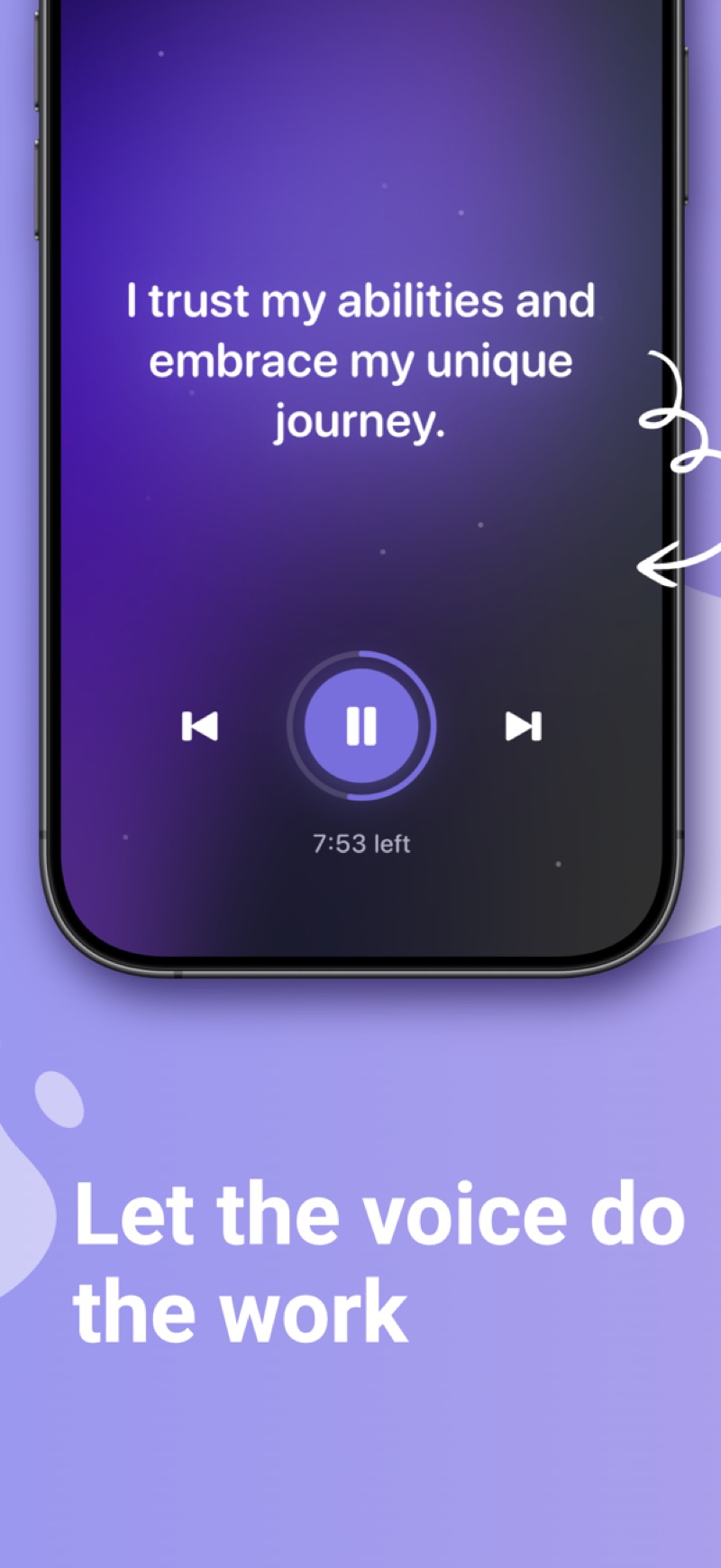
Look at the rules again: relaxed state, eyes closed, daily repetition, no friction. Reading fights every one of them; listening satisfies them by default. A spoken affirmation also carries tone — calm certainty your nervous system responds to — which is why guided meditation went audio-first decades ago.
This is the design premise of Here. You tell it what you're actually facing, in your own words, and it writes affirmations that pass rules 1–3 for your specific situation: believable, specific, present-tense. Then the audio experience handles rules 4–5 — a natural voice, calming background sound, a pace with room to breathe, and a session length that fits the habit slot you attach it to. You save the lines that resonate and drop the ones that don't, so your library keeps getting more believable, more yours.
How to run your own 14-day experiment
- Download Here and tell it one real thing you're working on — stress, sleep, confidence, a goal.
- Listen for 3–5 minutes at the same time every day for two weeks. Same trigger, same session.
- Save affirmations that feel true; regenerate ones that don't.
- After 14 days, check the thing you named in step 1. Affirmations done right don't announce themselves — they show up as a slightly steadier default.
Test it on your own life
Two weeks, a few minutes a day, affirmations written for your actual situation. Free to start.
Download Here freeThe bottom line
Do affirmations work? Generic ones, mumbled skeptically off a screen — mostly no. Personal, believable, present-tense affirmations, heard in a relaxed state, repeated daily — the evidence says yes: lower stress reactivity, less defensiveness, more follow-through. The practice works when the practice is designed right. That's the entire reason Here exists.